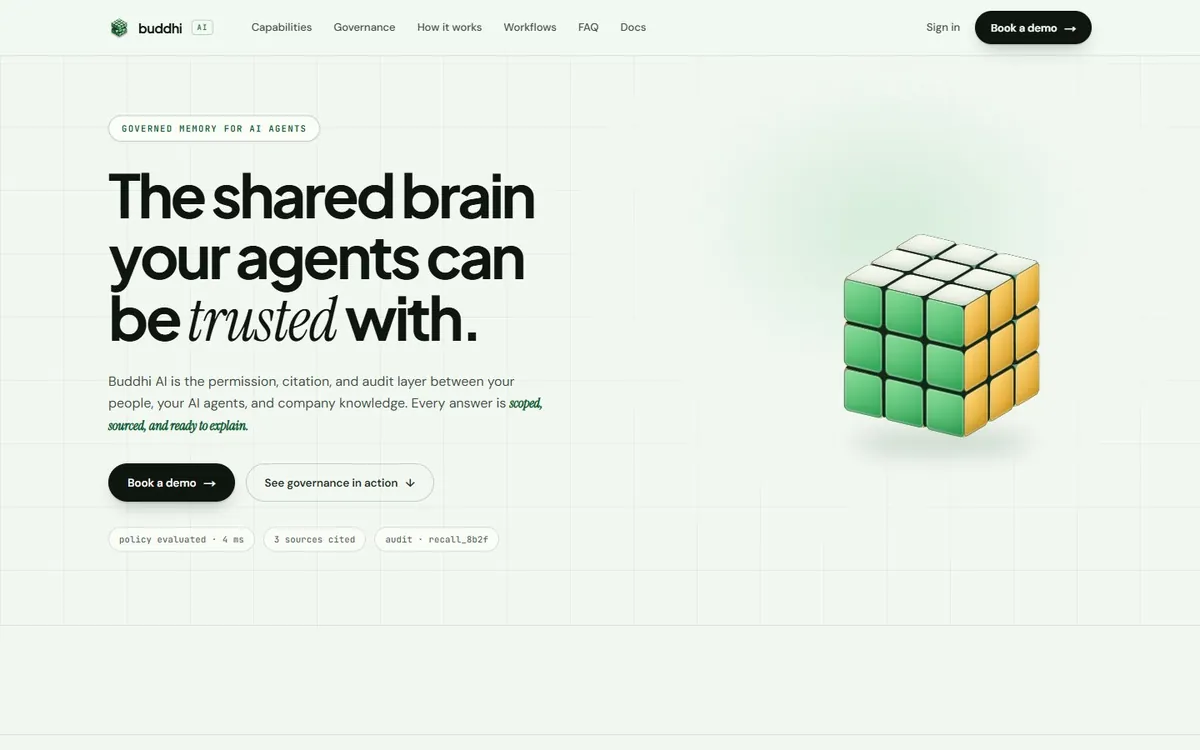
Buddhi AI
Deny by default: AI agents only see what the person asking may see, and every answer is cited and logged.
Client: HobbyFi · AI product · 2026 · Private beta, August 2026
Proves: AI Agents and Automation, MVP Build
The problem
Companies want AI agents that answer from company data, without an agent reading files the person asking is not allowed to see. Most cannot tell what their agents can reach.
What we built
A permission, citation and audit layer that sits between people, their AI agents and company knowledge.
Every request passes five checks: identity, role policy, scoped retrieval, redaction and audit. Answers come with citations. People and agents reach it through MCP, a CLI or a REST API, and every connector only reads.
The limit we built in
Never gives an agent context the person asking is not cleared for.
Deny by default, no anonymous queries, and connectors only read.
How it works.
People and their AI agents get cited answers from company knowledge, and never see more than the person asking may see. Green boxes are the checks where a run can stop.
- Agents leads to One MCP endpoint.
- One MCP endpoint leads to Identity (a check that can stop the run).
- Identity leads to Role policy (a check that can stop the run).
- Role policy leads to Scoped retrieval (a check that can stop the run).
- Read-only connectors leads to Scoped retrieval (a check that can stop the run).
- Scoped retrieval leads to Redaction (a check that can stop the run).
- Redaction leads to Cited answer.
- Redaction leads to Audit log.
The result.
Live at askbuddhi.com (opens in a new tab)Private beta, August 2026.
Who led it
 Vansh AroraFounding engineer
 Aditya GangwaniProduct
- Next.js
- PostgreSQL (Neon)
- Qdrant
- MCP
- Render
Next project
Rajaji National Park Safari
Every pre-booking question, from zones to ticket details and timings, answered on one site that ends in a booking form or WhatsApp.